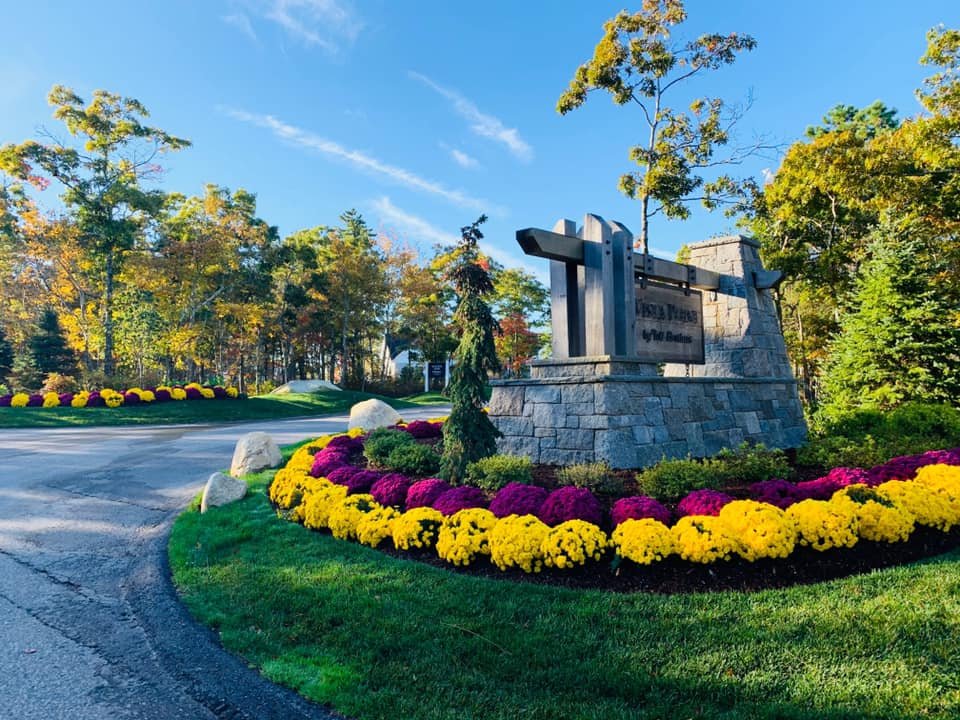
An entrance that floods every March, a common area nobody sits in, a walkway that residents have worn a shortcut around. Those are the problems that start a commercial landscape design conversation in Middleborough, MA, and none of them is a planting problem at heart.
Each one is a grade, drainage or circulation problem wearing a planting problem’s clothes.
Greener Horizon brings 20 years of experience to commercial properties across Eastern Massachusetts and manages the design, the hardscape construction and the planting installation on these projects with in-house crews.
That matters on an occupied property, because the people who set an elevation on paper are the people standing on site the week it gets cut.
Related: Retaining Wall Contractor in Middleborough, MA: The Height That Changes the Build
What Should Be Fixed Before Anything Is Planted on a Commercial Property?
Water should be fixed first on a commercial property, then grade, then circulation. A bed that fails twice in three years is usually sitting where the site sends its runoff, and replanting it a third time changes nothing.
Our commercial design and construction work starts with site improvements, retaining walls and grading, because a planting plan laid over an unresolved drainage path is a maintenance bill with a planting schedule attached.
Retaining and grading work stabilizes the property and makes ongoing care easier, which is the return a board sees for years after the crews leave.
How Does an Occupied Property Change Commercial Landscape Design?
An occupied property turns phasing into a design input instead of a scheduling detail. Residents still need to reach their doors, deliveries still arrive, and a fire lane stays a fire lane.
A plan drawn without a staging area and a traffic route ends up being improvised on site, which is where the complaints come from. Commercial projects are scheduled and phased to minimize disruption to tenants, residents and daily operations, and entrances and main drives are usually worth doing first and doing once.
Material deliveries and spoil removal belong in the same conversation, because on a tight site there is rarely anywhere to put either one.
Settling both on the drawing keeps a work zone from spreading into parking the property needs.
Which Areas Return the Most on a Multi-Property Site?
The areas people pass through return more than the areas they look at. Entrances, the lawns along main drives and the common areas near building doors shape the impression residents and visitors form.
After a season of heat, mowing and foot traffic, those are also the thinnest and most compacted areas on the property.
A small budget spent there reads larger than the same money spread evenly, and irrigation coverage and soil condition in those areas are worth checking before any planting is specified.
Related: Landscape Maintenance Services in Middleborough, MA: A Full Year on One Property
What Does Eastern Massachusetts Weather Do to Commercial Landscape Design?
Eastern Massachusetts weather sets the material and the detailing of a commercial design. Freeze and thaw cycles run repeatedly through a South Shore winter, so a walk or wall built without depth, clean aggregate and a drainage detail moves.
Salt exposure along drives narrows the plant list, and coastal wind narrows it again. These are design decisions, taken at the drawing stage, instead of problems to solve later.
Snow storage is the detail most often left out, and a plan that does not say where piles go produces a bed that is replanted every spring.
How Should a Board Compare Two Commercial Landscape Proposals?
A board should compare two proposals by asking each one what area it measured and what that area included, because two numbers for the same site often differ on scope instead of price.
HOAs, condo associations and office parks see this most often when one bid prices the full site and another prices only the visible planting.
Then ask what happens to the disturbed ground at the edges, and who is responsible for the plantings through their establishment period. Those two answers separate a finished job from one that needs a second contractor in year two.
Start Your Commercial Landscape Design While the Drainage Is Still Showing
Late autumn is the clearest reading a site gives you all year. A wet month shows where water collects and how long it sits, and a bare canopy shows the light the beds will get.
Walking a Middleborough, MA property now puts a resolved plan in hand before the spring calendar fills, for properties within about 45 minutes of Middleborough, including Plymouth, Kingston, Duxbury and Hanover.
Talk to Greener Horizon about commercial landscape design for the property you manage. Schedule your commercial landscape design walkthrough with Greener Horizon.
In Summary
Can design work and construction be contracted separately?
Design and construction can be contracted separately, but on an occupied site there is a cost to splitting them. Assumptions that did not make it onto the drawing get renegotiated in the field, usually during the week a crew is already mobilized, and keeping both under one contract means a single party owns the schedule when a trade runs late.
Who looks after new plantings through their first season?
First-season plant care should be named in the contract, because plants are at their most vulnerable in the first year. A site where installation and grounds care sit with different parties tends to produce an argument instead of a watering schedule, which is one reason Greener Horizon offers commercial maintenance alongside installation.
Is late autumn too late to start a site improvement project?
Late autumn is close to ideal for design and approvals, because those take calendar time instead of site time. Hardscape construction continues while the subgrade is workable, and planting is the part that generally waits for spring.
Related: Landscape Design Services in Middleborough, MA: What the Design Fee Buys